
Celebrating 100 Years
OF NEGRO HISTORY WEEK
Celebrating 100 Years of Negro History Week is an exhibition curated by Sophie G. Young
This exhibit commemorates the legacy of Negro History Week—founded by Dr. Carter G. Woodson—by tracing the enduring imprint of Black history within Cambridge and the broader American narrative. Through moments such as the presence of Rev. Dr. Martin Luther King Jr. at Harvard, the 1969 student-led Cambridge “sit-in,” and the leadership of local activists and educators, the works presented here illuminate how local acts of resistance, advocacy, and achievement shape national movements for justice.
Rooted in the understanding that Black history is inseparable from American history, this exhibition foregrounds the voices of students, activists, and leaders who transformed institutions and redefined civic life. In doing so, it honors a century-long tradition of remembrance while inviting viewers to consider how histories of struggle, community, and progress continue to inform the present and future.

1. Dr. Carter G. Woodson 1947
(62" x 47")
Carter G. Woodson, often called the “Father of Black History,” was the second Black person to earn a Ph.D. from Harvard University. Born to formerly enslaved parents, he dedicated his life to documenting and teaching the history of African Americans. In 1915 he founded the Association for the Study of African American Life and History and in 1926 created Negro History Week, the precursor to Black History Month. Through his scholarship and activism, he transformed how the nation would come to understand and reflect upon Black history.
Source: The Library of Congress

3. Dr. Edna Robinson Brown 1920s
(40" x 53")
Dr. Edna Robinson Brown was a pioneering force in the 1920s, becoming one of the first African American female dentists to practice in Massachusetts, and the first to do so in Cambridge. After graduating from Columbia University, she established a successful practice that served as a vital healthcare pillar for the local Black community. Beyond her clinical work, Dr. Brown was a dedicated civic leader and a founding member of the Psi Omega chapter of Alpha Kappa Alpha at Harvard College, the first Black Greek-letter sorority in the area.
Source: Psi Omega chapter of Alpha Kappa Alpha
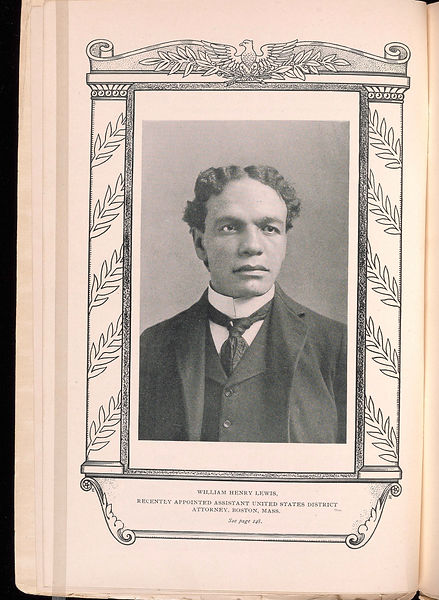
2. William Henry Lewis 1903
(66" x 47")
William Henry Lewis was a trailblazing lawyer and athlete based in Cambridge. A former Harvard football captain, he became the first Black Assistant U.S. Attorney General and a pioneer in the American Bar Association. His legal brilliance provided the framework for New England activists to dismantle segregation in housing and education.
During a 1904 game, as the head coach hesitated to play William Clarence Matthews, the team's only Black player, the following exchange occurred:
“Put in Matthews,” suggested William Henry Lewis... “He’s too light,” said the head coach. “Too light — and too dark,” retorted Lewis.
Courtesy of The Colored American


4. The Cambridge Community Center
1930s (66" x 47")
Founded in 1929, the Cambridge Community Center emerged as a response to segregation after a group of Black pastors found the local YMCA was “whites-only”. Operating out of a historic 138-year-old building, the Center was established to provide an inclusive space where Black families could find the opportunities and social services denied to them elsewhere. For 91 years, it has served as a sanctuary and a hub for community life. Today, it remains a permanent monument serving Cambridge families.
Courtesy of the Cambridge Community Center
5. Muriel S. Snowden 1940s (66" x 47")
Muriel Sutherland Snowden (1916–1988) was a pioneering community activist whose work significantly shaped civil rights and social justice efforts in Cambridge and Boston. In 1948, she became the executive director of the Cambridge Civic Unity Committee, an organization dedicated to fostering interracial understanding and civic participation in the city. Her tenure there laid the groundwork for her future endeavors in community organizing and advocacy.
In 1949, Snowden and her husband, Otto P. Snowden, co-founded Freedom House in Roxbury, Massachusetts, a center aimed at promoting effective citizen participation and interracial cooperation.
Courtesy of Courtesy of the Freedom House, Inc. records at Northeastern University Archives and Special Collections


6. Cambridge Civic Unity
Mid-1950s (66" x 47")
Founded during a pivotal era of social change, the Civic Unity Committee emerged as Cambridge's response to issues of discrimination, housing inequality, and civil rights. This exhibit traces the Committee's historic role in bringing together residents across racial and economic lines to advocate for a more just and inclusive city. Through archival photographs, and documents we can explore how ordinary citizens organized, mobilized, and created lasting change in their community. The Civic Unity Committee's story reflects Cambridge's ongoing journey toward equity and belonging.
Courtesy of Councilor E. Denise Simmons
7. Dr. Martin Luther King Jr. 1954
(40" x 59")
Dr. Martin Luther King Jr's graduate studies at Boston University shaped his foundation as a preacher and activist. During his time in Boston, King spent significant time in Cambridge, taking classes at Harvard and speaking at local churches, including a 1954 address to the Pullman Porters' Benefit Association and a widely attended 1960 sermon at First Baptist Church that emphasized nonviolence and Christian principles in the struggle for justice. His later 1967 visit to Cambridge connected the domestic civil rights movement to opposition to the Vietnam War, illustrating his growing understanding of the interconnectedness of racial, political, and economic justice. Across these visits, King's preaching and activism in Cambridge engaged the local community, underscoring both his national prominence and the broader global implications of the fight for equality.
Courtesy of the Cambridge Chronicle
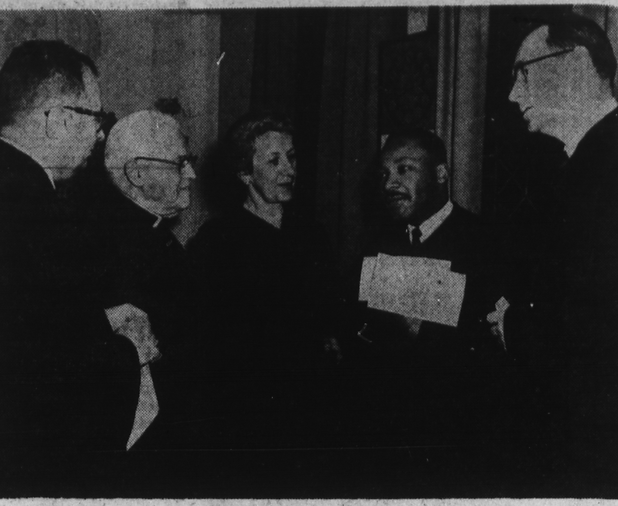

8. Dr. Martin Luther King Jr. 1962
(63" x 47")
Dr. Martin Luther King Jr. spoke on Harvard's campus multiple times, including a January 1965 appearance as guest minister at Memorial Church and a 1962 forum at Harvard Law School. During his 1965 sermon, King was warmly received by university leaders, greeting President Nathan M. Pusey and other guests.Courtesy of
Courtesy of the Harvard University Archives.
9. CRLS Cambridge “Sit-In” 1969
(32" x 38")
On January 10, 1969, a pivotal sit-in at Cambridge High and Latin School (now CRLS) marked a turning point for students in the city. Black students demanded a curriculum that reflected their own history and the hiring of more Black faculty. By the 1970s, these young activists had transformed the high school from a site of passive learning into a laboratory for social justice, proving that the next century of Cambridge history was already being written by its youth.“Racial tensions started rising. We were in the Civil Rights Movement just like everybody else, we were in the Black Power Movement just like everybody else, so there were racial tensions.” - Anonymous student
Courtesy of Councilor E. Denise Simmons


10. Nelson Mandela 1998 (32" x 38")
In 1998, Nelson Mandela arrived in Cambridge to receive an honorary degree—an honor granted only twice before outside of a commencement, once to George Washington and once to Winston Churchill. Standing before a crowd of 25,000 in Harvard Yard, Mandela bridged the global struggle against apartheid with the local traditions of activism that had long shaped Cambridge’s neighborhoods, including the Polaroid Revolutionary Workers Movement led by Caroline Hunter. His presence transformed the university grounds into a shared civic space, honoring a century of Black resilience and the “long walk” toward equality that links South Africa to the streets of Cambridge.
Courtesy of the Harvard Square Library
1. Stephanie Robinson and Ronald Sullivan Jr. 2025 (32" x 38")
In 2009, Stephanie Robinson and Ronald Sullivan Jr. made history as the first African American Faculty Deans (then known as House Masters) at Harvard College.The couple were already established leaders in the legal world: Robinson as a former Chief Counsel to Senator Edward Kennedy and a national media commentator, and Sullivan as a premier criminal defense attorney who helped free thousands of wrongfully incarcerated people. Today, they continue their legacy as professors at Harvard Law School.
Courtesy of Stephanie Robinson and Ronald Sullivan Jr.
