Good Trouble
A Focus on the Life & Work of Caroline Hunter
Good Trouble: A Focus on the Life & Work of Caroline Hunter is an exhibition curated by Sophie G. Young highlighting inspiring photographs taken in Cambridge and around the world from the 1970s to present day, celebrating the spirit of good trouble. Enter and learn about the extraordinary work of Caroline Hunter - activist, educator, scientist, Vice Chair of the School Committee, and co-founder of the Polaroid Revolutionary Workers Movement (PRWM). Vice Chair Hunter’s leadership helped spark a global movement that resulted in a successful boycott protesting Polaroid’s role as a supplier of photographic equipment to apartheid South Africa. Through powerful images of activism and protest, the exhibition honors her enduring commitment to courage, equity, and justice from Cambridge to the world.
The opening reception for Good Trouble was held on December 18, 2025 including fireside talk with Caroline Hunter and Mayor E. Denise Simmons. It served as the inaugural exhibition in the Mayor's Gallery at Cambridge City Hall—an initiative pioneered and established by Mayor E. Denise Simmons to highlight Cambridge's rich history and that of its local communities in a public, accessible space open to all.
The Mayor’s Gallery—a civic space dedicated to celebrating the creativity, diversity, and voices of our community—serves as the perfect venue for this exhibition. Designed to foster connection and dialogue among all who call Cambridge home, the gallery invites visitors to reflect, learn, and share, together.
Special thanks to Caroline Hunter and her daughter Lisette Williams.
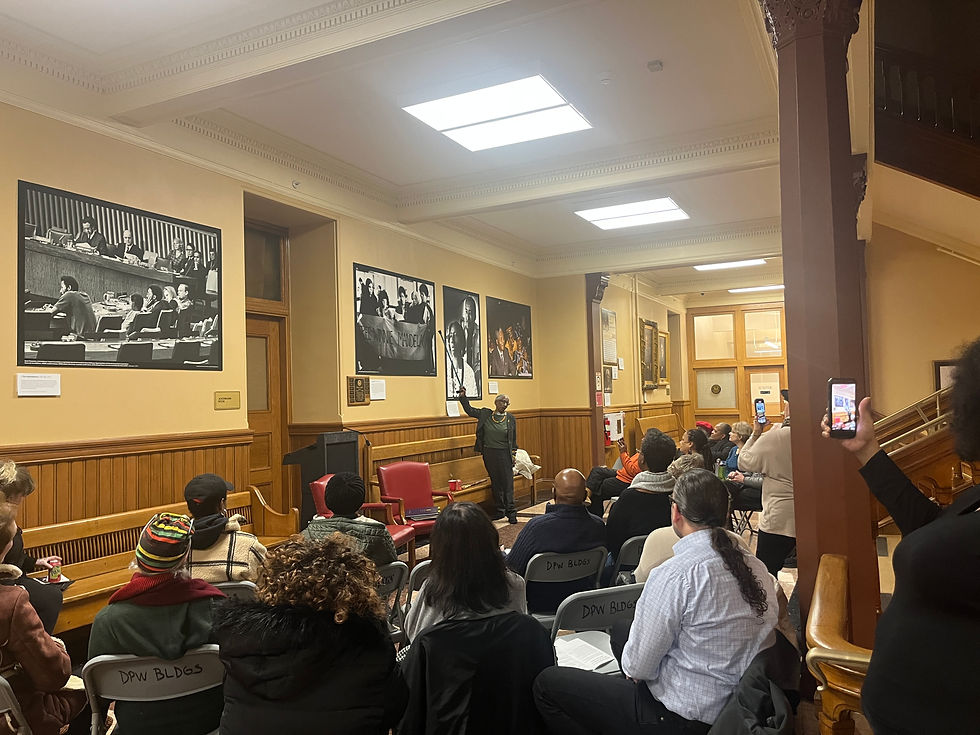


“The Mayor's Gallery exists for nights like this: to celebrate our community's voices, to foster dialogue, to be a place where we pause and reflect on who we were, and who we aspire to be. There is no more fitting venue for Caroline Hunter's story than right here.” - Mayor E. Denise Simmons
1. Polaroid Boycott Rally 1971 (62" x 47")
This photograph captures a public rally held near the main branch of the Cambridge Public Library — one of the many rallies held in close coalition of various labor, community, and university student groups in the early 1970s. These rallies were central to educating the public and building support for the Polaroid Boycott of apartheid South Africa. Here, Caroline Hunter addresses supporters, calling on workers and consumers alike to confront corporate complicity in human rights violations. This rally exemplifies how Ms. Hunter’s local organizing became a catalyst for international solidarity against apartheid.
Courtesy of Caroline Hunter


2. Caroline Hunter 1971 (40" x 53")
On July 4, 1971, Caroline Hunter spoke at “Britain and South Africa: Partners in Imperialism,” an international conference commemorating South African Freedom Day that was held at the Round House in London. As a paid guest speaker, Hunter’s presence at the conference underscored the global reach of the Polaroid Boycott. Her testimony connected grassroots, employee-led activism in Cambridge to a growing international movement that demanded accountability from governments and corporations alike.
Courtesy of Caroline Hunter, photo credit Ken Williams
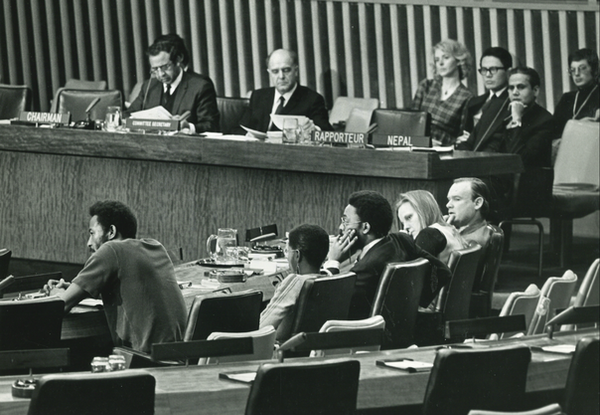
3. The United Nations 1971 (66" x 47")
Caroline Hunter and Ken Williams testified before the United Nations’ Special Committee on Apartheid on February 3, 1971, bringing international attention to Polaroid Corporation’s role in the South African passbook system. Pictured here, from left to right are: Ken Williams (PRWM), Caroline Hunter (PRWM), Robert Van Lierop (Journalist), Jenifer Davis (ACOA), and George Houser (American Committee On Africa).
Courtesy of Caroline Hunter, photo credit: United Nations

4. The WMSC 1978 (66" x 47")
Members of the Winnie Mandela Solidarity Coalition (WMSC) took over the First National Bank of Boston at South Station on March 8, 1978, International Women's Day, to protest the bank's involvement in South Africa and in solidarity with Winnie Mandela, who was in jail in South Africa at the time. They unfurled a banner, held a press conference, and read a statement before bank officials could summon the police to remove them and end the action. Members of the WMSC, from left: Mina Reddy (former Cambridge Adult Center Director), Nadine Cohen (fair housing activist), Caroline Hunter (co-founder Polaroid Revolutionary Workers Movement), Ginger Ryan (Day Care advocate & worker), and Juanita Wade (former Boston School Committee member). This photograph was digitized by Clarity Films.
Courtesy of Caroline Hunter
5. Hunter & Williams (40" x 59")
As co-workers at the Polaroid Corporation, chemist Caroline Hunter and photographer Ken Williams uncovered evidence of the company's involvement in apartheid-era South Africa. In response, they co-founded the Polaroid Revolutionary Workers Movement (PRWM) in 1970, mobilizing employees and allies to demand an end to Polaroid's business operations there. Their efforts drew international attention and support: they received positive responses from the United Nations Special Committee on Apartheid following their testimony, telegrams from the African National Congress and the anti-apartheid community, and encouragement from everyday people in Cambridge and beyond. Despite this support, Polaroid fired both Hunter and Williams in 1971. Their efforts, however, endured. In 1977, Polaroid formally withdrew all operations from South Africa, marking a successful employee-led challenge to U.S. corporate support of apartheid.
Courtesy of Caroline Hunter


6. The Mandela's Celebration 1990
(63" x 47")
Taken on June 23, 1990, this photograph shows Caroline Hunter with Nelson Mandela and Winnie Mandela at a celebration held at the Copley Plaza Hotel following Mandela’s historic rally on Boston Common. The event followed a luncheon hosted by Senator Edward Kennedy at the John F. Kennedy Library, which Hunter and Ken Williams attended. The moment reflects the long arc of struggle and solidarity. Two decades earlier, Hunter and Williams had helped expose how everyday technologies—cameras and filing systems—were used to uphold apartheid. Their local campaign in Cambridge became part of the global movement that ultimately helped bring apartheid to an end.
Courtesy of Caroline Hunter
7. Polaroid Employee ID Badge (32" x 38")
As co-workers at the Polaroid Corporation, chemist Caroline Hunter and photographer Ken Williams uncovered evidence of the company's involvement in apartheid-era South Africa. In response, they co-founded the Polaroid Revolutionary Workers Movement (PRWM) in 1970, mobilizing employees and allies to demand an end to Polaroid's business operations there. Their efforts drew international attention and support: they received positive responses from the United Nations Special Committee on Apartheid following their testimony, telegrams from the African National Congress and the anti-apartheid community, and encouragement from everyday people in Cambridge and beyond. Despite this support, Polaroid fired both Hunter and Williams in 1971. Their efforts, however, endured. In 1977, Polaroid formally withdrew all operations from South Africa, marking a successful employee-led challenge to U.S. corporate support of apartheid.
Courtesy of Caroline Hunter


8. Rosa Parks Award 2012 (18" x 18")
On July 1, 2012, Caroline Hunter received the Rosa Parks Memorial Award from the National Education Association in recognition of her lifelong commitment to human and civil rights. The award honored her role in exposing Polaroid’s support of South Africa’s apartheid system and organizing a successful boycott that led the company to withdraw from South Africa in 1977. Beyond PRWM, Ms. Hunter’s work helped spark the U.S. divestment movement and influenced congressional sanctions legislation. Her activism continued across decades, including privacy advocacy through People Against National Identity Cards (P.A.N.I.C.), public service appointments in Massachusetts and Cambridge, women’s international solidarity organizing, educational institution building, and participation in global human rights forums. This award affirms a legacy rooted in moral clarity, worker courage, and the enduring impact of principled resistance.
Courtesy of Caroline Hunter
National Education Association's Rosa Parks Award to Caroline Hunter
ADDITIONAL RESOURCES PROVIDED BY CAROLINE HUNTER
*PLEASE CLICK ON A TITLE TO DISCOVER MORE
AUDIOVISUAL: FILM, PODCASTS & RADIO
-
Caroline Hunter - "All About A Book", The Moth Podcast/ All Together Now: Fridays with The Moth
-
Business Insider Podcast 55: The Polaroid Revolutionary Workers Movement, Charles Herman, 2020
-
"The Bottom Line", Have You Heard From Johannesburg Films Series, Clarity Films
PRINT & DIGITAL MEDIA
-
Developing A Movement: How the Polaroid Revolutionary Workers Movement used printed matter to protest apartheid, Dr. Jovonna Jones, Boston Art Review, Issue 12: Some Assembly Required, Spring /Summer 2024, Boston, MA
-
Alchemy of Us: How Humans and Matter Transformed One Another, Anissa Ramirez, 2020
-
A People's Guide to Greater Boston, Nevins, Moodliar & Macrakis, 2020
-
Boston's Banner Years: 1965 - 2015, A Saga of Black Success, Melvin B. Miller, 2018